Customizing Your Identity: A Guide to the Credit Card Skin Canva Template
In an era where personal branding extends beyond social media profiles to physical objects, the desire to personalize everyday items has grown significantly. Among these items, credit cards serve as a ubiquitous symbol of financial identity. However, standard plastic cards often lack individuality, appearing identical to thousands of others in a wallet. This is where the Credit Card Skin Canva Template emerges as a practical solution for users seeking customization without the cost of premium metal cards or complex manufacturing processes.
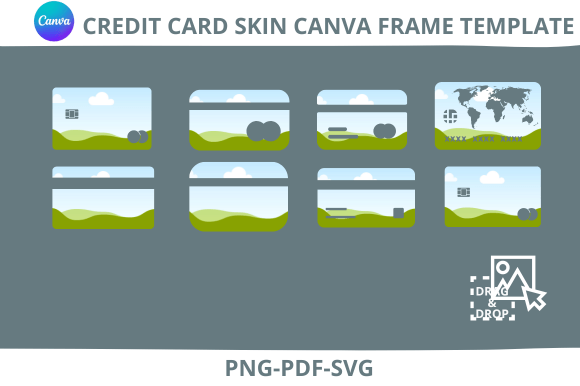
This tool allows individuals to transform a standard card into a unique statement piece using accessible design software. By leveraging drag-and-drop functionality, users can apply high-quality graphics to their payment instruments. The process involves selecting a specific frame designed for card dimensions, layering designs, colors, and patterns, and then exporting the result in formats suitable for printing, such as SVG or PDF. Unlike generic graphic design tools that require extensive training, this specialized template streamlines the workflow, making it accessible to anyone with a basic understanding of visual composition.
Understanding the Mechanics of Customization
The core utility of a Credit Card Skin Canva Template lies in its precision and ease of use. Standard design software often requires manual measurement and alignment to ensure a graphic fits perfectly within the ISO 7810 ID-1 standard used for most payment cards. This template bundle eliminates that friction by providing pre-scaled frames. Users simply upload their chosen artwork or select from provided assets, position them within the designated area, and download the final file.
The versatility of this approach is notable. Whether a user desires a minimalist aesthetic with solid colors, a complex pattern reflecting personal interests, or a collage of memories, the platform supports diverse creative expressions. The ability to export files as high-quality SVGs ensures crisp lines for vector-based designs, while PDF exports accommodate raster images and text layers effectively. This flexibility caters to both professional designers looking for quick mockups and casual users wanting to add a splash of color to their daily carry.
Comparing Approaches to Card Personalization
When evaluating options for customizing a credit card, consumers typically face a choice between official bank programs, third-party skin services, and DIY solutions like the Canva template. Each method presents distinct tradeoffs regarding cost, durability, and turnaround time.
- Official Bank Programs: Many financial institutions offer "custom" cards where you can choose a background image. While convenient and durable, these options are often limited to a curated library of stock photos or simple color choices. They rarely allow for full artistic freedom, and the turnaround time can be several weeks.
- Third-Party Skin Services: Specialized companies sell vinyl skins pre-cut to fit credit cards. These offer excellent protection and a wide variety of designs. However, they are recurring costs; if you want a different look, you must purchase a new skin. Furthermore, applying these skins requires patience to avoid air bubbles and peeling edges.
- DIY Canva Templates: Using a Credit Card Skin Canva Template places the control entirely in the user's hands. It is a one-time investment (or free) depending on the source, allowing for infinite variations without purchasing new materials. The primary requirement is access to a printer capable of handling the selected material, such as sticker paper or vinyl.
The DIY route via Canva offers a significant advantage in terms of iteration. If a design does not meet expectations, it can be tweaked and reprinted immediately. There is no waiting for shipping or paying for a product that might not match the desired aesthetic exactly. This makes it particularly appealing for users who frequently change their style preferences or want to create seasonal designs.
Evaluating Strengths and Limitations
To make an informed decision, it is essential to weigh the strengths of the template against its inherent limitations. The most compelling strength is the drag-and-drop simplicity. Users do not need to understand the technicalities of vector paths or print resolution settings. The interface handles the heavy lifting, ensuring that the final output aligns correctly with the card's dimensions.
Additionally, the integration with the broader Canva ecosystem allows for seamless collaboration. Designers can share templates with team members for feedback, or users can incorporate elements from their existing brand kits. This connectivity transforms the card from a static object into a dynamic extension of a larger design project.
However, there are tradeoffs to consider. The quality of the final product depends heavily on the user's printing capabilities. A professionally printed skin requires a printer with high-resolution output and appropriate adhesive materials. Home printers may struggle with certain vinyl textures or precise cutting, leading to a finished product that looks less polished than a factory-made card. Furthermore, the physical application of a self-printed skin requires care. If applied incorrectly, it can peel at the corners, potentially interfering with the card reader's magnetic stripe or chip.
Another limitation is the durability of home-printed skins compared to industrial laminates. While protective over-laminates can mitigate this, the lifespan of a DIY skin is generally shorter than that of a standard plastic card or a professionally manufactured vinyl wrap. For users who travel frequently or work in rough environments, this wear and tear might be a deciding factor against the DIY approach.
Decision Factors: When to Choose This Template
Determining whether the Credit Card Skin Canva Template is the right choice depends largely on the user's priorities. It is the ideal option for those who value creativity and cost-efficiency over long-term durability. Students, young professionals, and hobbyists who enjoy expressing their personality through their possessions will find immense value in this tool. It allows for rapid experimentation; one week a card might feature a geometric pattern, and the next, a photograph of a favorite landscape.
This approach is also beneficial for businesses or content creators who need branded merchandise quickly. Instead of ordering a bulk shipment of custom cards which takes time and money, a marketing team can design and print a small batch of skins for events or promotions instantly. The ability to customize each card individually means that every recipient gets a unique experience, enhancing engagement.
Conversely, users who prioritize convenience and longevity might find better alternatives. If a user travels extensively and cannot risk a card failing due to a peeling edge, a standard bank card or a high-end metal card replacement is more reliable. Similarly, those who lack access to a good printer or prefer not to deal with the mechanics of cutting and applying adhesives should consider purchasing pre-made skins or utilizing official bank customization features.
Practical Application and Workflow
Implementing a design using the Credit Card Skin Canva Template follows a logical workflow that maximizes efficiency. First, the user selects a template that matches the specific dimensions of their card. Next, they import their assets—logos, illustrations, or photos—and arrange them within the frame. It is crucial to account for the card's layout, ensuring that critical information like the name and expiration date remains visible or covered appropriately, depending on privacy preferences.
Once the design is finalized, the export phase is critical. Selecting the correct file format ensures compatibility with the printing material. For intricate line art, SVG is superior as it scales without losing quality. For photographic backgrounds, a high-resolution PDF is often preferred. After downloading, the user prints the design on the chosen adhesive material, cuts it to size (often using a craft knife or a die-cut machine), and applies it to the card.
This process empowers users to take ownership of their financial tools. It shifts the paradigm from passive consumption of standardized products to active creation of personalized ones. The satisfaction of holding a card that reflects one's own design choices adds a psychological layer of connection to the object, transforming a mundane transactional tool into a piece of personal art.
Navigating Alternatives and Future Trends
As digital wallets and contactless payments become more prevalent, the physical appearance of credit cards may seem less relevant to some. However, the tactile nature of physical cards remains important for many. The trend toward personalization suggests that the demand for unique physical identities will persist. Tools like the Credit Card Skin Canva Template sit at the intersection of technology and craftsmanship, bridging the gap between digital design and physical reality.
While other platforms offer similar framing capabilities, few combine the accessibility of Canva with the specific utility of card-sized templates. Competitors in the space often focus on selling the final product rather than the design process itself. By offering the template, users gain the agency to iterate endlessly. This aligns with the modern consumer preference for flexible, user-driven solutions over rigid, manufacturer-controlled products.
Ultimately, the choice to customize a credit card skin is a balance between artistic expression and practical necessity. The Credit Card Skin Canva Template provides a robust foundation for this endeavor, offering a blend of ease and flexibility that stands out in a market dominated by either mass-produced uniformity or expensive bespoke services. For the discerning adult aged 20 to 50 who values both aesthetics and autonomy, this tool represents a smart, adaptable resource for elevating everyday essentials.