Annual Budget Spreadsheet Template Excel: A Practical Guide to Financial Control
An Annual Budget Spreadsheet Template Excel serves as a foundational tool for anyone seeking to bring structure to their financial life. Unlike static documents or complex accounting software, this specific format offers a flexible, interactive environment where users can visualize their entire fiscal year at a glance. Whether you are an individual aiming to save for a major purchase, a family managing household cash flow, or a small business owner tracking operational costs, the ability to project income and expenses over twelve months is invaluable. This guide explores how to utilize this resource effectively, comparing it with alternative methods to help you determine if it fits your specific needs.
Understanding the Core Value of Annual Budgeting
The primary distinction of an annual budget spreadsheet lies in its temporal scope. While monthly trackers focus on immediate survival, an annual view forces a broader perspective. It allows users to identify seasonal fluctuations that might otherwise go unnoticed. For instance, a small business might see a dip in revenue during summer months, which requires strategic adjustments made earlier in the year. By using an Annual Budget Spreadsheet Template Excel, you create a roadmap that anticipates these shifts rather than reacting to them after they occur.
This tool is distinct because it combines high-level planning with granular detail. Most templates include automated calculations that update totals and balances in real time as you input data. This feature eliminates the tedious math often associated with manual budgeting, reducing the likelihood of human error. The template typically categorizes income and expenses, providing a clear breakdown of spending patterns. This categorization is crucial for understanding where money is going and identifying areas for potential savings.
Key Functionalities That Drive Decision Making
When evaluating an Annual Budget Spreadsheet Template Excel, several features stand out as particularly beneficial for long-term financial health:
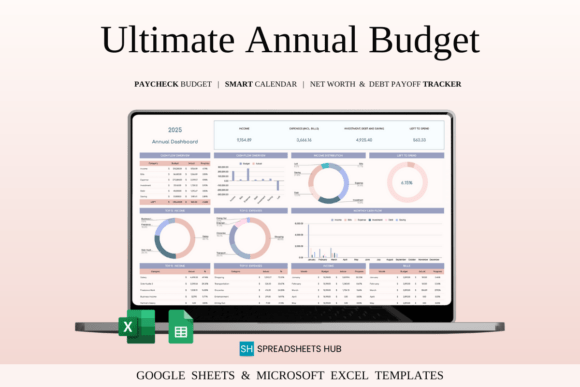
- Yearly Financial Overview: Monitor your financial health with monthly summaries and projections. This feature helps in better planning by showing the cumulative effect of daily spending decisions over the course of a year.
- Income Expense Tracker: Categorize and analyze your income and spending patterns. Understanding these patterns is essential for making informed decisions about where to cut costs or where to invest more resources.
- Savings Goal Tracker: Set and track savings targets for specific goals like vacations, emergency funds, or investments. Visual progress bars or percentage indicators can provide motivation and clarity on whether you are on track.
- Financial Reports: Generate year-end reports to evaluate your financial performance. These reports allow you to look back and assess what worked and what didn't, informing your strategy for the next cycle.
Comparing Spreadsheet Templates to Other Financial Tools
In the landscape of personal finance management, an Annual Budget Spreadsheet Template Excel sits alongside various other options, including dedicated mobile apps, subscription-based budgeting services, and simple paper journals. Each approach has its merits, but the choice often depends on the user's technical comfort, privacy preferences, and need for customization.
Flexibility vs. Automation
Dedicated budgeting apps often excel in automation. They can link directly to bank accounts to import transactions automatically, categorizing them instantly. However, this convenience comes with a trade-off: less control over data privacy and limited flexibility in how you define categories. If your financial situation involves unique income streams or non-standard expense categories that standard apps cannot accommodate, a spreadsheet becomes the superior choice.
An Annual Budget Spreadsheet Template Excel offers total customization. You can rename categories, add new rows for specific projects, or alter formulas to suit your unique calculation needs. This flexibility makes it ideal for freelancers with irregular income or families with complex household dynamics that don't fit into a generic app mold. However, this power requires a higher level of engagement; you must manually enter data or set up rules to import it, which demands discipline.
Cost and Accessibility
Many budgeting apps operate on a freemium model, charging for advanced features like investment tracking or debt payoff calculators. In contrast, an Excel-based template is often available for free or at a very low cost, requiring only the software you likely already own. Furthermore, spreadsheets do not rely on internet connectivity once downloaded, offering a layer of security and accessibility that cloud-based apps sometimes lack during outages.
Google Sheets is another strong alternative within the spreadsheet category. It offers similar functionality to Excel but excels in collaboration. If a family or small business team needs to edit the budget simultaneously from different devices, Google Sheets provides a seamless real-time editing experience. However, Excel remains the industry standard for complex modeling and robust formatting capabilities, making it a preferred choice for detailed financial analysis.
Who Benefits Most from This Approach?
While the utility of an Annual Budget Spreadsheet Template Excel is broad, certain groups will find it particularly transformative compared to other tools.
Individuals Seeking Deep Financial Literacy
For adults aged 20–50 who are actively learning about finance, building a budget in Excel is an educational exercise. It forces the user to understand the mechanics of cash flow, the impact of interest rates, and the importance of saving. The act of setting up the formulas and structure reinforces financial concepts in a way that clicking buttons in an app does not.
Families Managing Complex Households
Families often have multiple income sources, varying expense schedules, and shared goals. A spreadsheet allows parents to consolidate all this information into one view. They can track contributions to a joint vacation fund while also monitoring individual allowances for children. The ability to create separate tabs for different family members or goals within a single workbook offers a level of organization that fragmented apps struggle to match.
Small Business Owners
Small businesses require precise cash flow management. An Annual Budget Spreadsheet Template Excel can be adapted to handle payroll, inventory costs, tax estimates, and projected revenue. Unlike consumer-grade apps, business-oriented spreadsheets can be tailored to specific industry metrics. This adaptability ensures that the budget reflects the actual operational reality of the business, aiding in critical decisions regarding hiring, expansion, or cost-cutting.
Limitations and When to Look Elsewhere
To make an informed decision, it is equally important to recognize when an Annual Budget Spreadsheet Template Excel might not be the right fit. The most significant limitation is the requirement for manual effort. If you prefer a "set it and forget it" solution where your bank transactions populate your budget automatically, a spreadsheet may feel burdensome. The temptation to skip data entry can lead to outdated information, rendering the budget useless.
Additionally, spreadsheets lack the proactive alert systems found in modern banking apps. They do not send push notifications when you are approaching a limit or when a bill is due unless you build those triggers yourself. For individuals who struggle with consistency or forgetfulness, an automated app might provide the necessary external accountability that a static file cannot.
There is also a risk of complexity. If the template is too intricate, with too many interconnected formulas, a single typo can break the entire sheet. Users must be comfortable troubleshooting basic errors or willing to learn enough Excel skills to maintain the integrity of the document. For those who find technology intimidating, a simpler, albeit less powerful, option might be more appropriate.
Practical Steps for Implementation
Successfully utilizing an Annual Budget Spreadsheet Template Excel begins with preparation. Before opening the file, gather all relevant financial statements, including bank account balances, loan details, and recurring bills. Having this information ready streamlines the initial setup process.
Once the template is open, follow a structured approach. Start by populating the fixed income and expense sections, such as rent, salaries, and utilities. Then, move to variable expenses, estimating based on historical data. Finally, set your savings goals. The template's automated calculations will immediately show you if your current trajectory meets your objectives. If there is a deficit, use the data provided by the spreadsheet to adjust discretionary spending categories until the numbers balance.
Regular maintenance is key. Treat the spreadsheet as a living document. Update it monthly, ideally within the first few days of the new month, to compare your projections against actual results. This review process highlights variances and allows for timely corrections. Over time, your estimates will become more accurate, and the spreadsheet will evolve into a highly personalized financial dashboard.
Making the Final Decision
The choice between an Annual Budget Spreadsheet Template Excel and other financial tools ultimately rests on your personal workflow and priorities. If you value transparency, customization, and a deep understanding of your financial mechanics, the spreadsheet is a powerful ally. It empowers you to take full ownership of your financial narrative without relying on third-party algorithms.
Conversely, if your priority is speed, automation, and passive tracking, a dedicated app may serve you better. There is no single "best" tool; there is only the tool that best supports your specific habits and goals. By weighing the tradeoffs of flexibility against convenience, and manual effort against automation, you can select a method that ensures your financial goals are met sustainably throughout the year.